Showing posts with label history. Show all posts

That's what you get for supporting a movement called "Know Nothing."

Published circa 1856 in Boston and composed by "A. Barrel Apples," the song "The wheelbarrow polka" (also known as "The cider polka") was dedicated to Major Ben. Perley Poore.


Poore, a popular journalist in the mid-1800's, made a bet with Col. Robert L. Burbank that former U.S. President Millard Fillmore (of the soon-extinct Whig Party) would win the Presidential election of 1856 (this time running with the American Party of the anti-immigrant, anti-Catholic Know Nothing Movement).  The loser had to wheel a barrel of apples from his own home to the winner's home (Poore lived in Newbury, Massachusetts; Burbank in Boston -- 36 miles apart).

Fillmore lost and thus did Poore (James Buchanan won) so he spent over two days on the road pushing an apple cart to Boston while cheered by an audience lining his lengthy route. 

A larger version of the image above can be viewed hereIf you're interested in the sheet music, it can be viewed here

:D / D:

By Oscar Lewis regarding Albert Maurice Bender:  "A.M.B.:  some aspects of his life and times, begun in playful mood for his entertainment of his 75th birthday and now completed for his sorrowing friends as a token of remembrance and affection."

Born in 1866 and dying 3 1/2 months before his 75th birthday, Bender was an important figure in the San Francisco art world during the 1920s and '30s.  Born in Dublin to a German Jewish couple (his father was a rabbi), he immigrated to the U.S. in his teens under the care of his uncle in San Francisco.  Another uncle hired him to work in his insurance company and the young Bender eventually became a successful broker.

His cousin, Anne Bremer, a respected San Francisco artist, inspired Bender to begin collecting art just as he had collected rare books in his younger years.  Focusing his collection primarily on the work of local artists (and art from China, Japan and Tibet), he was also interested in knowing the artists and writers themselves, thus becoming acquainted with many of them.  His monetary assistance played a large role in the cultural development of the Bay Area art scene and helped launch careers -- most notably, that of photographer Ansel Adams by financing the publication of his first portfolio and first book.

Additionally, Bender was a prolific donor of artwork to many state galleries, museums and libraries (as well the National Museum of Ireland which received 260 pieces of Asian art in memory of his mother).  He was also one of Diego Rivera's first American patrons and co-founder of the Book Club of California.  Oscar Lewis, the author of "A.M.B.," was once secretary of the club.  A San Francisco writer and historian, Lewis died in 1992 at the age of 99.

Mr. Parker's motto: "Hard work never killed anyone."

From circa 1911, the 131-page "In sacred memory of William Thornton Parker, Jr., 1876-1900" regards a young Harvard law student who'd graduated MIT with top honors and "scarcely [took] any time for meals and little for sleep" in his pursuit of higher education.

According to news reports at the time of his death, Parker was taking an exam in constitutional law (which he was pursuing as a specialty) when he suddenly "went insane."  Hands on his head, he started to scream "Constitutional law!" before his tone became "agonized" and he followed with moans and "unintelligible sentences."  He died a few days later.

The reports claimed he perished of "an abscess on the brain" caused by "intense mental strain" -- or "overstudy."  Modern belief is that he died of an aneurysm -- which is apparently what was believed at the time by those not seeking juicy headlines:  The death notice appearing in the Harvard Crimson mentions neither an "abscess" nor "insanity" as the cause of his demise but, rather, what it very likely was -- a cerebral hemorrhage.

By the way, the title of this post came from a comment on a blog entry about Parker, found here, where you can find reproductions of the newspaper reports as well as a link to the Crimson obituary (which, as one would expect, doesn't hint at all to the dramatic scene that occurred during what could now be humorously referred to as an exam able to drive one to deadly madness).

"Please, place your right hoof on the Bible."

A fellow coworker used to keep a list of interesting titles on the wall in our former office. One of them was "The Criminal Prosecution and Capital Punishment of Animals."

Published in 1906, the book was no joke--until the 1700's (possibly the 1800's), non-human creatures were occasionally (though not at all rarely) brought to trial in Europe. Thus, courtroom defendants (in both church and secular courts) were sometimes common pests such as rats and snails, as well as domesticated animals, such as horses and dogs.

But especially the pig. History of non-human criminal sentencing is rather rife with records of swine execution for criminal acts. In fact, the first known animal trial was that of a pig near Paris accused of killing a child and sentenced by monks to public burning. Another pig, also convicted of killing a child, was killed in snout-for-a-snout manner in the town square--executed in the same way it had "murdered" its alleged victim.

But not all the non-human executions were put on public display. Just as for humans at the time, though many were sentenced to burn at the stake, some were doomed to live burial, some to "knocks on the head," and others to imprisonment and subjection to the rack.

The latter practice is a good example of how humans and non-humans were treated equally in trial and prosecution--for though judges knew that non-human beasts could not utter the confession normally expected from a trip to the rack, the gears of justice were sworn to turn no differently for any defendant--human or otherwise.

The belief that non-human creatures lack a moral judgment that thus excludes them from the ability to commit murder or engage in criminal damage of property with the same awareness of a human is a common modern notion. But for the many centuries that non-humans (and even some corpses and inanimate objects) were tried and executed for alleged crimes, beliefs and understanding of the world were quite different in some ways than in most of today's modern cultures.

For one thing, there was a wide belief in "familiar spirits"--supernatural entities thought to aid witches and others in the practice of magic (whether "good" or "evil"). These intelligent spirits were believed to have the ability to manifest themselves in different forms--including that of humans. Perhaps that's why the aforementioned sow executed in the town square was first dressed in human clothes.

But it's more likely that the poor, persecuted pig was simply born in the wrong place at the wrong time--when humans and non-humans were believed more equal in some ways than they are now. Sadly, where we met eye-to-eye was in a position of potential eye-for-an-eye punishment.

But the belief of human/non-human equality lives on in some. Thankfully, in more reverent ways. For instance, when Charles Baudelaire conjured in verse the image of a cat as a "familiar spirit" of its home, he was merely expressing admiration in a way similar to Jean Cocteau's later quote that cats eventually become a home's "visible soul."

Speaking of Cocteau, he had another quote that reminds me a little of this topic: "An artist cannot speak about his art any more than a plant can discuss horticulture." Just as a cow that has broken your fence can moo neither a plea of "guilty" nor "not guilty."

Don't mess with a ghost ship...

In the summary section of a card:  "Material concerning the 1990 attempt of the trimaran Great American to challenge the San Francisco-to-Boston record of the clipper ship Northern LightGreat American was co-skippered by Marblehead sailor Rich Wilson."

One needn't wonder long on the outcome of the endeavor when glancing at the subject section:  "Clipper-ships," "Sailing," "Shipwrecks."

Great American II
The two-member team attempting to break the 1853 record of Northern Light (76 days and six hours) were tossed in the turbulence of a storm not far west of Cape Horn (that is, just before rounding the southern bend towards Boston) and Great American capsized on Thanksgiving Day (later being turned upright by the storm--a first in recorded history).  The ship was lost, the two men were saved, and Northern Light kept its record until 1993 when Wilson and a different shipmate broke the standing record on Great American II (completing the journey in 69 days, 20 hours).

For more on the 1990 event, see Rich Wilson's telling of the adventure.

"I'll have the Salman Rushdie with a side of Spring Rice."

The Lord Monteagle of Brandon in 19th century Ireland, Thomas Spring Rice gained his tasty surname (sometimes hyphenated) through the family-name combo of his parents, Catherine Spring and Stephen Rice.

"...whole fruitful valleys, being now everwhelmed and drowned with these most unfortunate and unseasonable salt waters..."

From 1607 England: "God's warning to his people of England, by the great overflowing of the waters or floudes, lately hapned in South-Wales."

At the time of the Bristol Channel floods of 1607, many believed them to be the work of God (as can be seen in the above pamphlet title) as a punishment for a "most wicked and pretended malice" by "traitors that ... practiced" some sort of "subversion of this beautiful kingdom [England]."

Scientists in later times felt the likely cause was a great storm but modern researchers, after reviewing contemporary reports and eyewitness accounts, now believe that the cause was a tsunami, perhaps triggered by an earthquake from an unstable fault off the coast of Ireland.

"...[H]uge and mighty Hilles of water, tumbling one over another, in such sort as if the greatest mountaines in the world, has over-whelmed the lowe Valeys or Earthy grounds."

--From "God's warning..."

Survivors talked of water that rushed in too fast to be escaped on foot, that the day had been a sunny one, and that the sea receded before the wave arrived--on top of which sparks were seen. All of these descriptions--as well as modern physical evidence--seem to support the tsunami hypothesis.

But whatever the cause, the flood covered roughly 200 square miles of farmland and killed an estimated 3,000 people and an abundance of livestock--not only by drowning but by being trapped in trees for too long or for other reasons that led to, among other things, starvation:

"...[M]any that had great store of Corne and Grayne, in their Barnes and Garners in the morning had not within five hours space afterwards, so much as one Grayne to make them bread withall : Neither had they so much left as a lock of Hay or Straw to feede their catell which were left: Such was the great misery they susteyned by the fury of this watry Element, from which like, good Lord I beseech him of his infinite mercy and goodnes to deliver us all."

--From "God's warning..."

In addition, the flood swept away so many homes and other buildings that some villages were entirely erased by the waters that ultimately rose to a height of eight meters above sea level. Needless to say, the local economy was as devastated as the land and its communities. But for many, the event and their survival held important meaning:

"Thus god suffred many of them to escape his yrefull wrath, in hope of their amendment of life ...

"This mercylesse Water breaking into the Bosome of the firme Land, hath proved a fearfull punishment, as well to all other living Creatures: as also to all Mankinde: Which if it had not binne for the mercyfull promise of God, as the last dissolution of the World by Water, by the signe of the Rainbowe, which is still shewed us: we might have verily beleeved, this time had bin the very houre of Christ his comming: From which Element of Water, extended towardes us in this fearefull manner, good Lord deliver us all Amen."

--From "God's warning..." which can be read in its entirety here: Great Flood of 1607, where are also a few other contemporary reports, including one which featured in its original printing the woodcut above.

Nope, they aren't pseudonyms...

Willy Rickmer Rickmers, Victor von Richter, and Oliver Onions (yes, pronounced just like the vegetable).

Willy Rickmers was an explorer (and son of shipbuilder Rickmer Clasen Rickmers); von Richter was a chemist; and Oliver Onions was born (the same year as Rickmers) George Oliver Onions -- a commercial artist who later became a prolific writer publishing under his middle and surname (even after legally changing his name to George Oliver in his mid-40's).  A long-lived fellow, he died in his late 80's, in 1961, but his wife, fellow author Berta Ruck, won the race, dying at age 100 in 1978.

When the Romani and rapscallions get together, better bring a stash of granola...

Printed in 1753 Dublin and written by Henry Fielding, Esq.: "A clear state of the case of Elizabeth Canning, who hath sworn that she was robbed and almost starved to death by a gang of gipsies and other villains in January last, for which one Mary Squires now lies under sentence of death."

The case of Elizabeth Canning was a media circus in 18th century England on par with the modern-day O.J. Simpson trial.  And, as with Simpson's story, the full truth was never discovered and supporters of both sides writhed outside the courthouse walls then roiled with anger or joy at word of the final verdict.

The protagonist of this story was a poor 18-year-old maid in 1753 England.  Her claim was that while walking home one night, she was attacked by two men who took her to a house where she was asked to become a prostitute.  She refused, at which time Squires, a gypsy, allegedly took Canning's corset, slapped her, and forced her into the loft where she remained for nearly a month surviving on roughly one loaf of bread and a small amount of water.  After losing her long-held belief that she would one day be released, she escaped by removing a board near a window, jumping to the ground and walking for five hours back to London where she arrived at her mother's home emaciated and filthy, wearing ragged clothes she claimed to find in the loft.

At the time of Canning's case, assault wasn't generally investigated or tried, but Mary Squires was charged with stealing, and robbery at that time was often punishable by death.  For this reason, a trial took place and the assault could then receive legal attention.

But having her story scrutinized in court might be why Canning didn't rush to the police.  But, then, she couldn't--she was quite sick when she returned and it was only after questioning by friends and, later, a local alderman, that an arrest warrant was issued for Squires as well as the owner of the house where she claimed to be held, Susannah Wells.  In the end, other people who were involved or present during the alleged crimes were called to trial (though some had fled) but only Wells and Squires were to be punished--the former by branding of the hand and six months in prison; the latter by hanging.

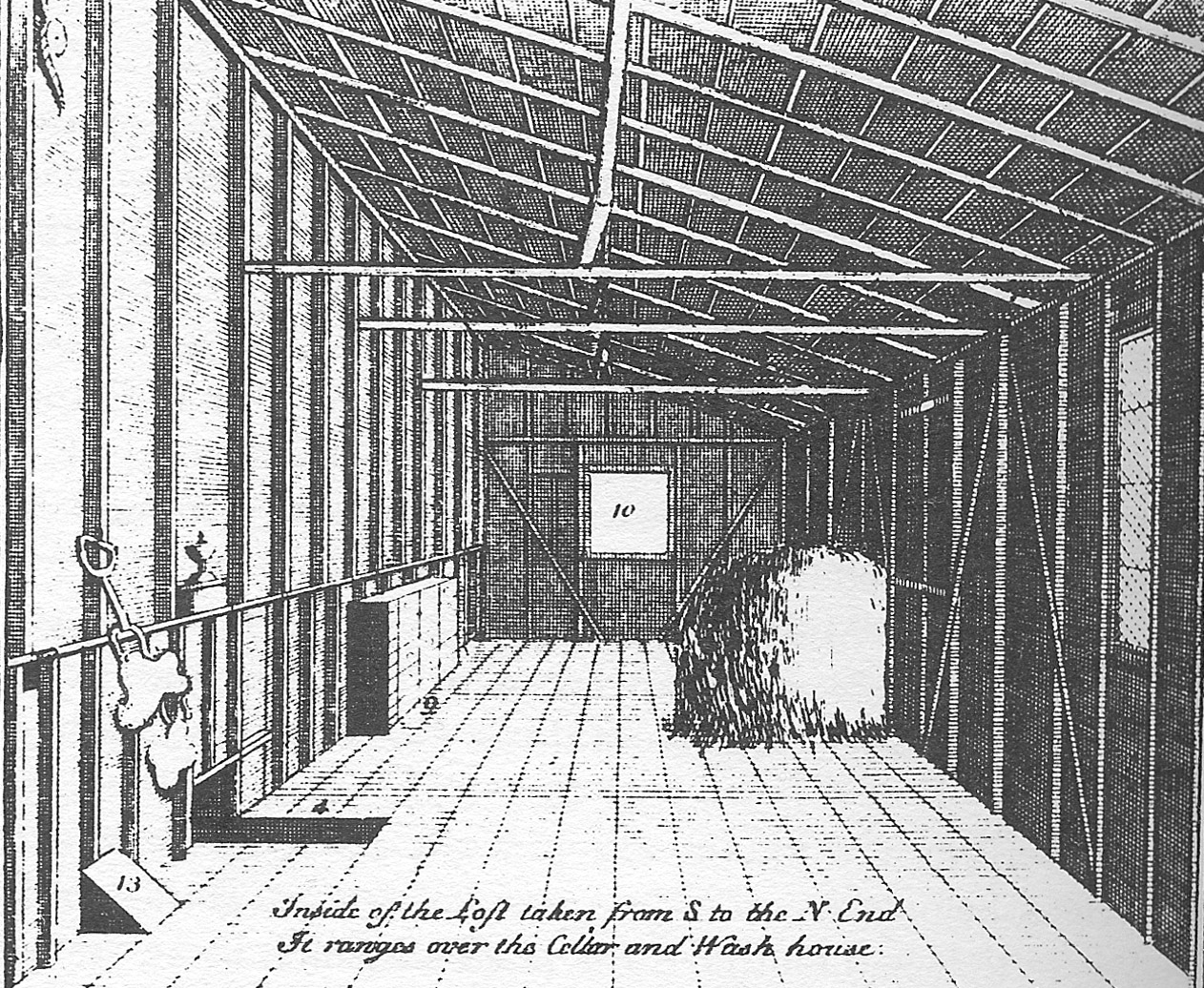
An 18th century drawing of Canning's alleged loft prison.
But the trial judge (and current Mayor of London) along with several of his colleagues doubted Canning's story.  Thus, the judge began his own private investigation and, after many interviews, he felt certain that Canning was lying and thus had her arrested on charges of perjury.  By the judge's request, King George II granted Squires a stay of execution and, eventually, a pardon.  But Susannah Wells was not so fortunate--she served the entirety of her prison sentence.

Ultimately, Canning was found guilty and sentenced to one month in prison then seven years of transportation (i.e., the common English practice of the time to deport criminals to distant penal colonies, usually).  Sent to Connecticut a year and a half after her reappearance at her mother's doorstep, it was arranged for her to live with a minister (who died the following year).  Two years after arrival, at age 22, Canning married and eventually gave birth to four children.
Possibly 19th century portrait of Squires.

Because the truth of Canning's disappearance has remained a mystery, theories naturally bloomed in the wake of it all.  Though some assume partial amnesia played a role, a common speculation is that she went into hiding to keep secret a pregnancy and, thus, also lied in court and suffered imprisonment to continue shielding her virtue.  Whatever the truth, it disappeared with Canning when she died suddenly at the age of 38 in 1773--three years before her new home became its own nation.


Now, in keeping with this blog's frequently recurring mentions of unusual and interesting names, here are some bits along those lines found in the tale of Elizabeth Canning:

Firstly, her mother was also named Elizabeth, as was her daughter (and a daughter of Wells).  Not so strange, especially for the time, but then there's her father's name, William:  One of Canning's attorneys was named Mr. Williams and both an attorney for the prosecution and the court recorder were both named William.  Also in the courtroom saga were the surnames Willes and Willis.  And the minister she lived with in Connecticut was, like her, the offspring of a William and Elizabeth.  And Canning was also living with the minister's wife--Elizabeth!  And the minister's father--and a son--were named William Williams!

Other mind-tickling monikers in the Elizabeth Canning story:  Crisp Gascoyne, the judge and London mayor who disbelieved Canning; Gascoyne's son, Bamber; a supporter of Canning called Nikodemus; and two characters at risk of prosecution but later dismissed:  Fortune Natus and Virtue Hall.

"Doc, I can't breathe." "Drink more water." "Doc, what about this frightful rash?" "Take a long bath."

A coworker showed me this title one day and commented, "That's kinda taking snake oil to a whole new level."

From 1846 New York, James Gully's "The Water Cure in Chronic Disease : An Exposition of the Causes, Progress, and Terminations of Various Chronic Diseases of the Digestive Organs, Lungs, Nerves, Limbs, and Skin, and of Their Treatment by Water, and Other Hygienic Means."

It's certainly a lofty claim this book's title alone seems to imply but the idea of water ("and other hygienic means") being a potentially potent tool in the treatment and curing of diseases was no doubt a fairly controversial idea in the medical world of the mid-1840's.  In fact, it would be another two decades before Joseph Lister developed a sterilization technique for medical purposes--and even longer before American medicine commonly accepted his ideas.  The modern practice of the sterilization of tools, hands, etc. prior to surgery seems an obvious necessity to us today but it wasn't until about 1890 that American surgeons largely adopted these methods.

In fact, doctors who've studied the 1881 case of assassinated U.S. president James Garfield believe that he would likely have survived his wounds if those tending to him had used sterilized tools and hands to probe his body in search of a missing bullet (Alexander Graham Bell even designed a metal detector specifically for the case but the bedsprings interfered with the function of the device).  After the shooting--which occurred a mere four months after his taking office--Garfield survived for eleven painful weeks before numerous infections (likely due to the unsterilized probing) brought about his death.

A few years later, I imagine these fellas threw a helluva beirfest!

Published in 1886 Switzerland by Cooperative Print Shop, the publishing information of this book includes a long phrase in German which translates into English (by Google Translate) as:  "in the merry month of the eighth year of the Socialist Law-shame."

As whimsical and/or humorous as that translation may sound, I must tell you that "Wonnemonat" is actually the German word for May and translates literally to "Month of delight" or "Month of joy" so, technically, Google was right.

As for the rest of it, well, the Sozialistengesetz (or "Socialist Law," though really it was anti-Socialist law) was a series of acts passed in 1878 Germany after two failed attempts to assassinate Kaiser Wilhelm I.  These unsuccessful threats to his life were believed to have been influenced by the growing strength of the Social Democratic Party and, so, the new laws were meant to cripple the organization by limiting the dissemination of socialist principles in a variety of ways (including the shutting down of nearly 50 newspapers, the banning of the party's propaganda, and not allowing the formation of groups or meetings with the intent of spreading socialist views).

The acts were ultimately unsuccessful, however, as the Social Democratic Party continued to gain in popularity. This result was no doubt a happy one for those affiliated with this book (the title of which I didn't note) for it was published (outside of Germany, unsurprisingly) in May 1886--a month after the third extension of the Sozialistengesetz--with a phrase that seems to indicate that the book's creators viewed Germany's anti-Socialist law as shameful.

Fortunately, female nervous systems improved during the 20th century...

Excerpt from previously mentioned Grace Goodwin's "Anti-Suffrage: Ten Good Reasons" published in 1912 (my own notes, clarifications and assumptions are in brackets):

Colleges have occasionally declared marriage to be a lamentable end to a woman's "career," a sad falling off from the "higher life."  Talking will not change matters, nor argument eradicate the fact that as long as the race has a mother, that mother will have to be a woman, and if a woman is not a mother she has failed, either voluntarily or involuntarily, to do the only thing for which, in the original scheme of creation, she was intended.

Therefore, the assuming of political duties [primarily voting, of course, but--as later detailed--also "...carrying out of political plans,...attending political conventions,...doing jury duty..."], as many women must assume them in the event of a granted franchise to all adults properly qualified, must be not substitutional, but additional.  We cannot wholly, nor even in large measure, evade our own duties and responsibilities, and to these we must add the burdens and duties of men.  There is nothing of a woman's natural duty which a man can do as well as a woman, yet, with amusing arrogance, women claim that they will be able easily to do the work in which for centuries men have been specially trained,--to do this work as well as he, or better than he, and to do their own at the same time.

Let us just state frankly a few things which every woman knows.  During all the forceful period of a woman's life she labors under distinct disabilities on account of her sex; it trips her up at every turn; many women are in a constant state of rebellion because they absolutely must take some sort of care of themselves or be invalided out of the race.  In the carrying out of political plans, in attending political conventions, in doing jury duty, a woman will be at the mercy of her nature.  For one whole year, if a new life is to emerge [i.e., if a child is to be born from her pregnancy], she is unfit to assume additional risk in the overstrain of her normally taxed nervous system.  Maternity is an exhibition of a woman's nervous system taxed to a normal limit, and normally entirely equal to the strain.  But while pregnancy is not a pathological condition, it is the limit of nerve-tax.  Presumably there are other children and a home.  How much more ought a woman to do?  And for every woman married or single, during the greater part of her life, there is the plain and unchangeable fact that she lives in a periodic nervous cycle [i.e., women have a menstrual cycle], when the life-forces are normal, below normal, and again normal, and that during the below-normal period she is again very nearly at the nervous limit.  Why pretend that these things are negligible?  Every woman knows they are not, but she fears the derision of other women if she admits it.  Where, then, is her surplus strength, where the extra force to be expended in political excitements?

Every student of industrial conditions, every one who tries to wrestle with the new science of eugenics, recognizes that the danger to the working girl which transcends all other dangers, is the danger to her motherhood [presumably either or both that working in industrial environments could cause the loss of a woman's ability to become a mother due to the strain on her nervous system (and, thus, her "life-force")--which would weaken her so that she might be unable to conceive and/or carry a child to birth--or that she may die (as a direct result of the job or due to the "nervous system strain") and, thus, be eliminated as a potential provider of children to her society], and that the paramount danger to the state in her industrial life is the loss of so many potential mothers; for the great wheels eat up the nerve-forces of a woman's life; the standing, the treading, are perilous to her feminine powers.
--Pages 86-89

The average woman has as much brains as the average man, and average persons are going to do the greater part of the voting, but the woman lacks endurance in things mental; her fortitudes are physical and spiritual.  She lacks nervous stability.  The suffragists who dismay England are nerve-sick women.
--Page 92

Want to read the entire book?  You can do so here, at Google Books. (It seems that the first page or few of the text is missing from their copy.)